

Hair System Color Guide: What Every Shade Means and How to Avoid a Bad Match
- Written by Maisie Martin
- | Published Oct 13, 2026
- |
- 5 min read
 Listen to the full text
You've picked your base, your density, your style. Then you hit the color dropdown and freeze. #1? #1B? #2? They all look black on screen.
That makes sense, because color decides whether a hair system looks like your own hair or like it belongs to someone else. A good match disappears. A shade that’s slightly off pulls eyes straight to your hairline, even if people can’t explain why.
You don’t have to guess, though. Matching color follows a short process, and once you’ve been through it, choosing from that dropdown gets a lot easier.
Key Takeaways
- Match to your sides and back, the hair that's still there, not the color you had at 25.
- When you're stuck between two shades, go lighter. A slightly lighter shade blends more forgivingly than one that's too dark.
- Natural daylight is the only light you can trust. Bathroom bulbs lie.
- Three ways to get matched: color ring (hands-on), email photos (convenient), hair sample (most accurate).
- Gray is a percentage, not a color. It's blended with your base shade (1B30 means #1B with 30% gray).
Where to Start AKA Matching to Your Natural Hair
Here's something most people don't realize: the hair on your head is not one flat color. It gradients.
The back of your head is normally the darkest part. Your temples and sides are usually about one shade lighter. And the crown and front are often two or more shades lighter than the back.
I picked this up from Lordhair's stylist training manual, and it changed how I think about matching. If you take one color from the back of your head and put it on your whole system, the front will look too dark or too harsh against your forehead.
So where do you start? With the hair that's still growing, your sides and back. That's the hair your system has to blend with. If you're bald on top, that's your only living reference. Use it.
Quick how-to: wash your hair, dry it, no product. Product changes how color reads. Then look at it in natural daylight. That's your baseline.
Quick Reference: Common Shades and What They Match
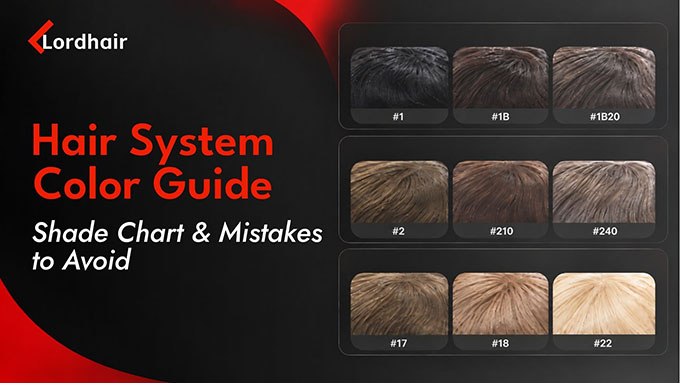
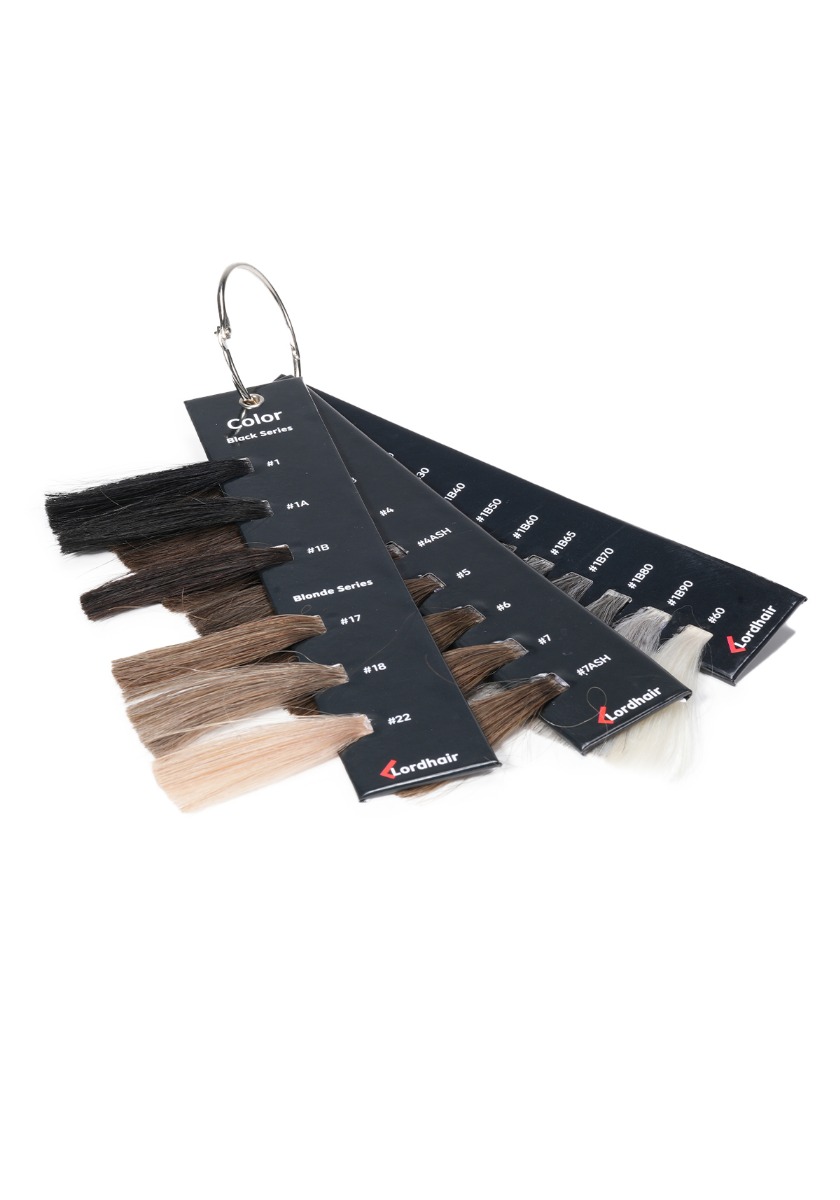
Let's get practical. Here are the shades you'll see most often, and who they actually match. View all the available Lordhair hair colors.
|
Code |
Shade Name |
Who It Matches |
Notes |
|
#1 |
Jet Black |
Very dark East Asian, some African hair |
True jet black. Most people who think they're #1 are actually #1B. Can look artificial on lighter skin. |
|
#1A |
Natural Black |
People with naturally black hair that isn't flat jet-black . |
True natural black: softer/less harsh than #1 (sits between jet black and off black), no brown undertone (that's what distinguishes it from #1B). |
|
#1B |
Off Black |
Most "black-haired" Caucasian, Latino, Middle Eastern, South Asian |
The most popular dark shade. Natural black with subtle brown undertones, not flat. Safer than #1 for most people. |
|
#2 |
Dark Brownest |
Very dark brown that reads almost black in low light |
One step lighter than 1B. Good if your hair shows visible brown in daylight. |
|
#3 |
Dark Brown(1 shade lighter than #2) |
Classic dark brown hair |
Very common. Visibly brown but still dark. |
|
#4 |
Medium Dark Brown |
Medium brown with depth |
One of the most popular brown shades. Also available as #4ASH (cool/ashy version). |
|
#5 |
Medium Brown |
True medium brown |
Lighter than #4, warm neutral tone. |
|
#6 |
Medium Light Brown |
Light-medium brown |
Good for lighter brown hair or sun-lightened ends. |
|
#7 |
Light Brown |
Light brown/dirty blonde border |
Also available as #7ASH. The lightest "brown" before blonde. |
|
#17/#18 |
Dark Blonde |
Dark blonde/light ash brown |
For naturally blonde or heavily highlighted hair. |
|
#22 |
Light Blonde |
Natural light blonde |
The lightest standard men's blonde on stock systems. |
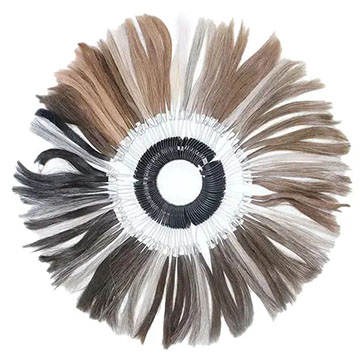
Lordhair color rings hold every Lordhair shade as real hair swatches. Compare them against your own hair and find the closest match before you order.
What About Gray?
If you have gray, it's not a separate color; it's a percentage blended with your base. The code tells you everything: 1B30 = #1B Off Black with 30% gray. 365 = #3 Dark Brown with 65% gray. Standard increments for stock hair systems are 10%, 20%, 30%, 40%, 50%, 65%, and 80%.
One note on gray hair material: for lower gray percentages, Lordhair uses synthetic gray hair because human gray hair tends to develop a yellowish tint over time. For 60% gray and above, we switch to human gray hair because it looks more realistic at those levels.
Just starting to gray and only in a certain area: with Custom Systems you have more choice about where you want your grays located, whether it be just the back or the temples of your system.
To learn more about gray hair systems, refer to this guide on How to Choose a Gray Hair Toupee for Men
See how the right color blend and customization can make all the difference.
Between Two Close Shades: Go Lighter or Darker?
Go lighter. A finished hair system usually looks a little darker than the swatch you matched it to. Thousands of hairs knotted close together on a base reflect less light than a small loose bundle, so the color deepens once it’s on your head.
Say you’re stuck between #3 and #4. Pick #4 and it will likely look closer to #3.5, which lands right between the two shades you were deciding on. Pick #3 and it could look more like #2.5, darker than either option. This effect gets stronger with higher density, so if you’re ordering Medium-Heavy or Heavy, the case for going lighter is even stronger.
A slightly lighter unit also blends better where the system meets your own hair as it grows out. Lighter is easier to fix, too. A color rinse can deepen a unit in one sitting. If it’s too dark, it may require bleach, which dries the hair out and shortens its lifespan.
The Exception: Very Dark Hair
If your sides and back are very dark (#1, #1B or #2), match your side hair as closely as you can instead of going lighter. Near-black hair has very little room to look any darker, so the density effect barely shows. A lighter shade, on the other hand, can bring out a brown tone that stands out against black hair at the blending zone.
How to Find Your Natural Hair Color Number
There are four ways to find your code, and each one suits a different situation:
- Email photos: The fastest option. Send a few daylight photos to support@lordhair.com, and our team will recommend a shade. Screens shift color a little, so treat it as a starting point.
- Color ring: Real hair swatches you can compare with your sides and back at home. Once you’ve found your shade, you can return the ring for a full refund. Learn more about how to use Lordhair color rings.
- Hair sample: The most accurate option. We match your actual hair and keep the sample on file for future orders.
- AI Virtual Try-On: Useful for seeing how a shade looks with your skin tone. Upload a photo to get a preview. It’s not a precise match, so confirm with one of the options above.
For detailed guidance on choosing a , guide on choosing a men’s hair color for a hair system.
Common Color-Matching Mistakes
1. Matching in the Wrong Light
The #1 mistake. Warm yellow bulbs make hair look more golden, red, and darker. Fluorescent light makes it look ashier and flatter. Phone screens add their own cast. Only trust natural indirect daylight, and check in at least two lighting environments before committing.
2. Matching to Old Photos or "Your Old Color"
Your hair changes with age, sun, medication, and graying. The hair you had at 25 isn't the hair you have at 40. Match to your current sides and back; that's your only truth if you have hair loss on top. Don't match to a memory.
3. Going Too Dark
The most common mismatch. Systems read darker than swatches, and too-dark creates a halo/block effect. When in doubt, go lighter.
4. Using Flash or Filtered Photos
Flash washes out depth and changes tone. Filters are obvious, but people still use them. Mirror selfies flip and distort. Raw, unedited, well-lit photos taken by someone else- that's what gets you a good recommendation.
5. Treating Gray as an Afterthought
Underestimate gray, and the system looks too dark and "dyed." Overestimate it, and you look older than you are. Gray isn't evenly distributed on real heads (more at the temples, less at the crown). Custom orders can replicate that. If you are not sure, use Lordhair's 4-step gray matcher or virtual try-on for gray percentages.
Conclusion
The codes in the dropdown follow a simple scale. The lower the number, the darker the shade, so #1 is jet black and #22 is light blonde. Gray works as an add-on: the number after your base color tells you how much gray is mixed in, so 1B30 is off black with 30% gray.
To find your spot on that scale, match to the hair on your sides and back as it looks today, and check it in natural daylight. If two shades look close, pick the lighter one, unless your hair is very dark. In that case, match it as closely as you can.
Not sure which to choose? Start with the Try-On. If you’re still torn after that, contact us for a free consultation and we’ll help you decide.
see the look


FAQs
Can I dye my hair system if the color is wrong?
Yes, you can darken a system with a rinse or semi-permanent color. Lightening requires bleach and will damage the hair, shortening its lifespan, which is another reason to go lighter if you're unsure. Pre-colored systems from Lordhair also last longer than self-dyed ones.
How do I know if I have warm or cool undertones?
Check the veins on your wrist: green veins mean warm, blue veins mean cool. Or think about how you tan: tans easily = warm, burns easily = cool. Warm tones suit golden/red shades (R suffix); cool tones suit ashy shades (ASH suffix).
What does a color code like "1B30" mean?
The first part (1B) is your base color, and the number after it (30) is the gray percentage. So 1B30 = #1B Off Black with 30% gray hair blended in. Standard gray increments for stock hair systems are 10%, 20%, 30%, 40%, 50%, 65%, and 80%.
Can I send a photo for color matching?
Absolutely. Email photos to support@lordhair.com. Take them in natural daylight (no filters, no mirror selfies), from multiple angles (front, back, roots, ends), with hair down and loose. A specialist will recommend a shade. Note: screen-based matching has slight variance, so for a guaranteed match, send a physical hair sample.
How long does color matching take?
Photo matching: usually within 1–2 business days. Hair sample: once received, matched within 24 hours. Color ring: instant once you have it in hand, it ships within 24 hours of ordering.
What if the color arrives and it's wrong?
Lordhair offers First Purchase Assurance. If the color isn't right, contact support@lordhair.com, you may be able to exchange or return. Adding a color ring to your initial order means you can return both for a single return fee if the match is off.